This post is guest authored by Dr. Beatrice Guenther, who was the moderator of this panel discussion.
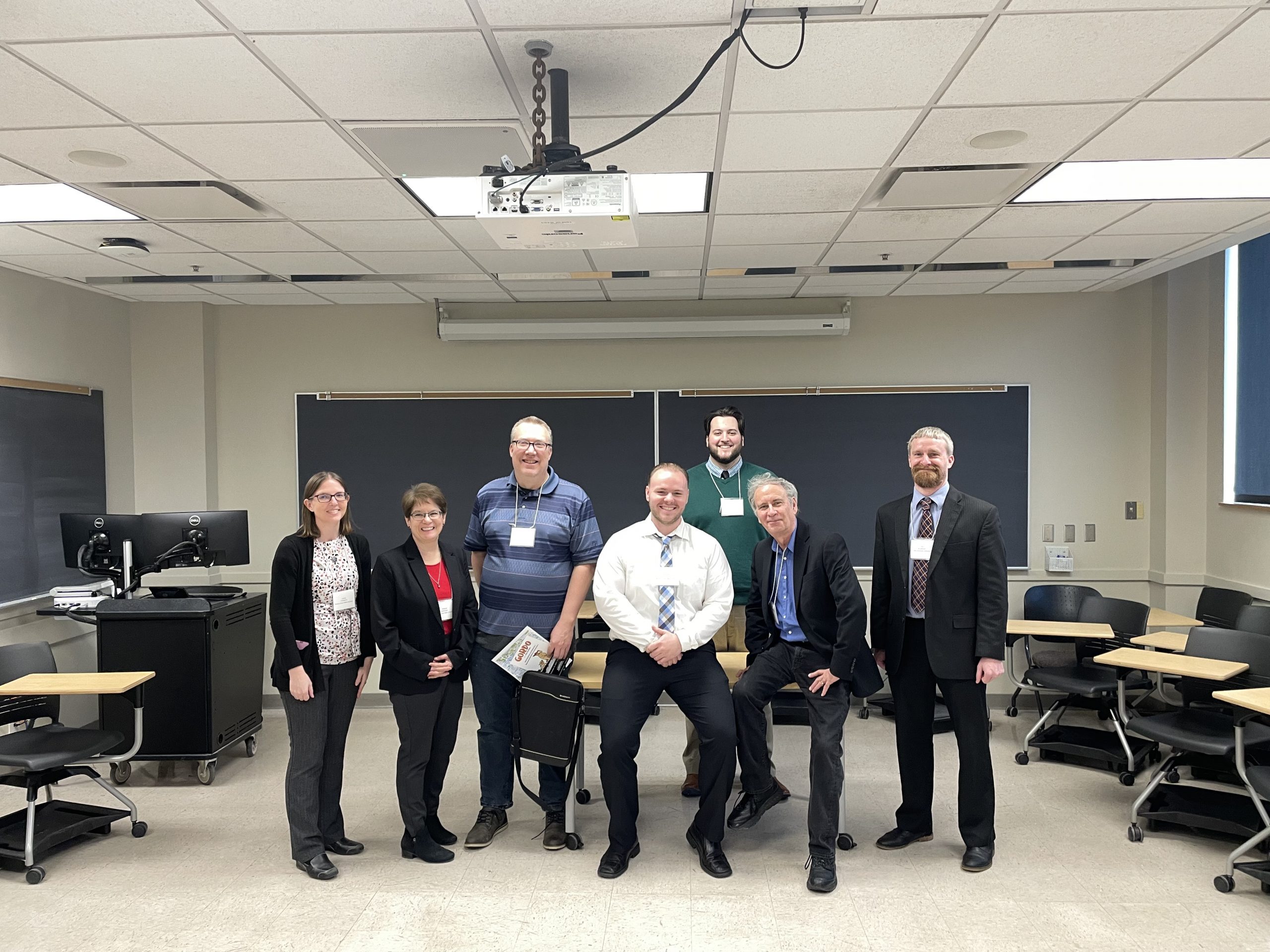
News about the multifaceted crisis in Iran, its neighbors, Israel, and the United States have filled headlines around the world. As a way to make sense of a variety of shifting news reports, the Program of International Studies proposed a panel on “Iran in Context” on Thursday, April 9th. Dr. Andrew Kunze (Asian, International Studies, and History) organized the interdisciplinary panel, which included specialists at BGSU from Ethnic Studies, History, International Studies, and Political Science. Dr. Beatrice Guenther, Director of International Studies & Professor, World Languages & Cultures/French, served as moderator.
In her March lecture, historian Dr. Jesse Vander Heide explored the hidden social worlds of young women in 19th-century American boarding schools, revealing how these institutions were both sites of control and unexpected spaces of resistance.
In December, 2025, the Department of History welcomed alumnus Ed Kruszynski (’84) for a powerful public lecture and book talk on his two works, The Medic’s Wife and Unbreakable. Throughout the talk, he invited our students and members of the community to see World War II not only through battle lines, but through the intimate lens of a family archive—what he called a “time machine” into the 1940s.
This post is guest-authored by History MA student, Roberto Rios.
Robin Wall Kimmerer, mother, enrolled member of the Citizen Potawatomi Nation, Native American botanist, professor, and author, spoke with community members and students at Bowling Green State University on Friday, March 27, in Kobacker Hall of the Moore Musical Arts Center, and at the Veterans Memorial Building at the Bowling Green, City Park, Saturday, March 28. Dr. Kimmerer, discussed themes from her book Braiding Sweetgrass: Indigenous Wisdom, Scientific Knowledge, and the Teachings of Plant, and her perspective of interacting with the environment to a combined crowd of over 1200 people from across the region.
What began in 2016 as an effort to make a history methods assignment more engaging has evolved into research on a difficult but important topic: the history of hazing in American universities.
This blog post is cross-posted from Dr. Challu’s blog, which you can find at blogs.bgsu.edu/achallu
Last week Heidi Nees, jenn stucker and I hosted Ciara Cotter and Chris Houk of the Wyandotte Nation Cultural Division. They came from Oklahoma to lead a program on Wyandotte storytelling, an event of the In The Round series.
≈ Comments Off on BGSU Faculty panel explored Venezuelan crisis in roundtable discussion
On a cold day in January, BGSU faculty convened a roundtable discussion examining the implications of U.S. intervention in Venezuela and what it reveals about today’s changing international system. The panel included History Chair and Faculty member, Dr. Amilcar Challu, Dr. Valeria Grinberg, Professor of Spanish and Director of the Institute for the Study of Culture and Society, Dr. Michaela Domiano, Associate Professor of Ethnic Studies, Dr. Neal Jesse, Chair of the Department of Political Science, and Dr. Beatrice Guenther, Director of the International Studies program.
Dr. Challu argued that U.S. involvement in Venezuela fits a long historical pattern of intervention in Latin America and signals a shift away from the post–World War II, rules-based international order toward openly asserted strategic and economic interests. Using the 1989 U.S. invasion of Panama, Dr. Grinberg showed how interventions framed around democracy and human rights often obscure violent realities, warning that today’s discourse on Venezuela reflects a troubling erosion of even that rhetorical commitment.
Dr. Domiano focused on Venezuelan migration through the Darien Gap, highlighting the extreme dangers migrants face and emphasizing the crisis as a humanitarian catastrophe shaped by regional and global forces, while Dr. Jesse placed Venezuela within the broader collapse of the liberal international order. He argued that global politics is increasingly organized around spheres of influence and power competition rather than international norms and institutions.
Dr. Beatrice Guenther helped to moderate the conversation, and framed the discussion around Venezuela as both a regional crisis and a lens for understanding larger transformations in global politics, guiding the discussion across historical, political, and human dimensions. Together, the panelists offered a sobering assessment of the changing state of the world in respect to the newest developments of U.S. intervention in Venezuela.
Back in September, one of our adjunct faculty and History alumni, Chase Fleece, offered a sobering historical perspective on today’s turmoil in agriculture in his public lecture at Carter Historic Farm. Set within this living history site operated by the Wood County Park District, Fleece linked modern financial stress for farmers to the infamous farm crisis of the 1980s. He described how farmers back then built their operations on massive debt, expanded recklessly, and ultimately suffered when land values collapsed, interest rates surged, and global conditions shifted.
Fleece warned that the problems of the ’80s were not just a moment in time, but the beginning of chronic instability in farming. He pointed out that many of the vulnerabilities of that era—debt reliance, volatile commodity prices, and shaky faith in government support—are resurfacing today. Although today’s farmers have more protective measures like loan programs and crop insurance, Fleece argues that the legacy of past crises still shapes present-day agricultural challenges.
Farmers, beneath the weight of plummeting commodity prices and ballooning debts, tried to grab the nation’s attention by any means necessary. The burning of a John Deere B in effigy on the National Mall in February 1979 illuminated the widespread feelings of betrayal and hopelessness among the country’s agriculturalists. Photograph courtesy of the Smithsonian Institute Archives.
His research, which stretches beyond U.S. borders to examine similar crises in Canada and Europe, underscores a critical lesson: agricultural instability isn’t isolated—it’s deeply interconnected across time and place. As Fleece continues to shed light on the patterns linking past and present, his work highlights not only the financial but also the human stakes in understanding how historic farm policies still echo through rural communities today.
Chase Fleece has presented research about the 1980’s Farm Crisis in other contexts, which has won him the George S. Sulzner Memorial Award. We would like to congratulate Chase on being offered a full-time position in Wood County Parks as a historical specialist/interpreter. You can read more about his talk in September at BG Independent News, and you can hear his next public lecture on November 23rd.
≈ Comments Off on History faculty joins colleagues on panel at inaugural Great Lakes AI Week Conference
Dr. Savitri Kunze, Associate Professor of History, recently joined colleagues from across campus for a lively interdisciplinary panel titled “Human-Centered Creativity in an AI World.” Moderated by Rob Green from the Department of Computer Science, the conversation brought together faculty from diverse creative fields: Lucas Ostrowski, (Department of Theatre and Film), Divya S (School of Media and Communication), and Charles Tucker (School of Art) in addition to Dr. Kunze and Dr. Rob Green. Talking to a full room in the Bowen-Thompson Student Union, panelists explored how artificial intelligence is reshaping the creative process, from accelerating learning and offering new tools to collaborating as a “co-creator” in artistic and scholarly work. Yet, they also raised thoughtful concerns about AI’s potential to manipulate truth, produce “hallucinated” results, and overshadow the human element of creativity.
Despite these challenges, the panelists agreed that AI cannot replace the soul, lived experience, and “unexpected, messy” aspects that define human creativity. Each discipline brought its own historical relationship to tools and innovation. The various faculty members emphasized that while AI can simplify tasks like writing or brainstorming, it remains just one instrument among many. The discussion encouraged participants to engage critically with AI—acknowledging its contributions without stigmatizing its use—and to continue nurturing the human spark that drives discovery and art at BGSU.
≈ Comments Off on Falcon History Society celebrates Dia de los Muertos
This post is authored by Falcon History Society President, Allessandro Martinez Leon.
As the last of the Halloween candy is running out and the scares are wearing off, a new celebration comes out to take the stage. Day of the Dead (Dia de los Muertos) is one of the most popular Mexican traditions, celebrated on November 1st and 2nd, these are days of remembrance for those family members or friends that we have lost.
The Falcon History Society created a Dia de los Muertos altar in Williams Hall at the end of October, 2025.
Originated in a mixture between ancient Mesoamerican customs and the Catholic feast of All Saints Day brought by the Spanish, Day of the Dead held an important role in the lives of Mexican families. This time of year has traditionally been set aside for mourning, while also celebrating the lives of their deceased loved ones.
Following the Mexican Revolution in the early 20th century, the new government sought to establish a national identity, and Day of the Dead became a tradition chosen to be symbols of the new Mexican society. A set of rules were established to give uniformity to the holiday, which was what the Falcon History Society followed to build our altar.
The altar is built in layers, where one puts their loved one’s pictures and/or objects that were meaningful to the lost loved ones. The altar is then decorated by crepe paper and sugar skulls. We used sugar skull recreations made of ceramic, and hung marigold flowers around Williams Hall. These flowers are significant because they become a trail so that the dead know where to go. Finally, food is added so the dead can eat. Families would usually put their loved one’s favorite dishes or alcohol, but most famously there will also be Pan de Muerto, a type of sweet bread sprinkled with sugar.
Falcon History Society members decorated the hallways and stairs with crepe paper flowers and tea light candles to show the way for lost family members to find the Dia de los Muertos altar.
Falcon History Society members (and History Department Chair, Dr. Amílcar Challú) had fun building this altar together. It was full of sweet moments for us to remember those we lost, but we know will always be in our hearts.